
How Digital Twins and AI Are Improving Chiller & HVAC Plant Optimization
Facility managers and energy engineers today face increasing pressure from rising energy costs, tighter sustainability targets, and aging HVAC infrastructure. Traditional optimization approaches—fixed schedules, manual setpoint tuning, and reactive maintenance—are no longer sufficient to maintain efficient chiller plant operation under continuously changing load and weather conditions
Digital twin technology, when combined with artificial intelligence, offers a structured way to address these challenges—not by replacing engineering judgment, but by supporting better operational decisions.
What a Digital Twin Means in HVAC Systems
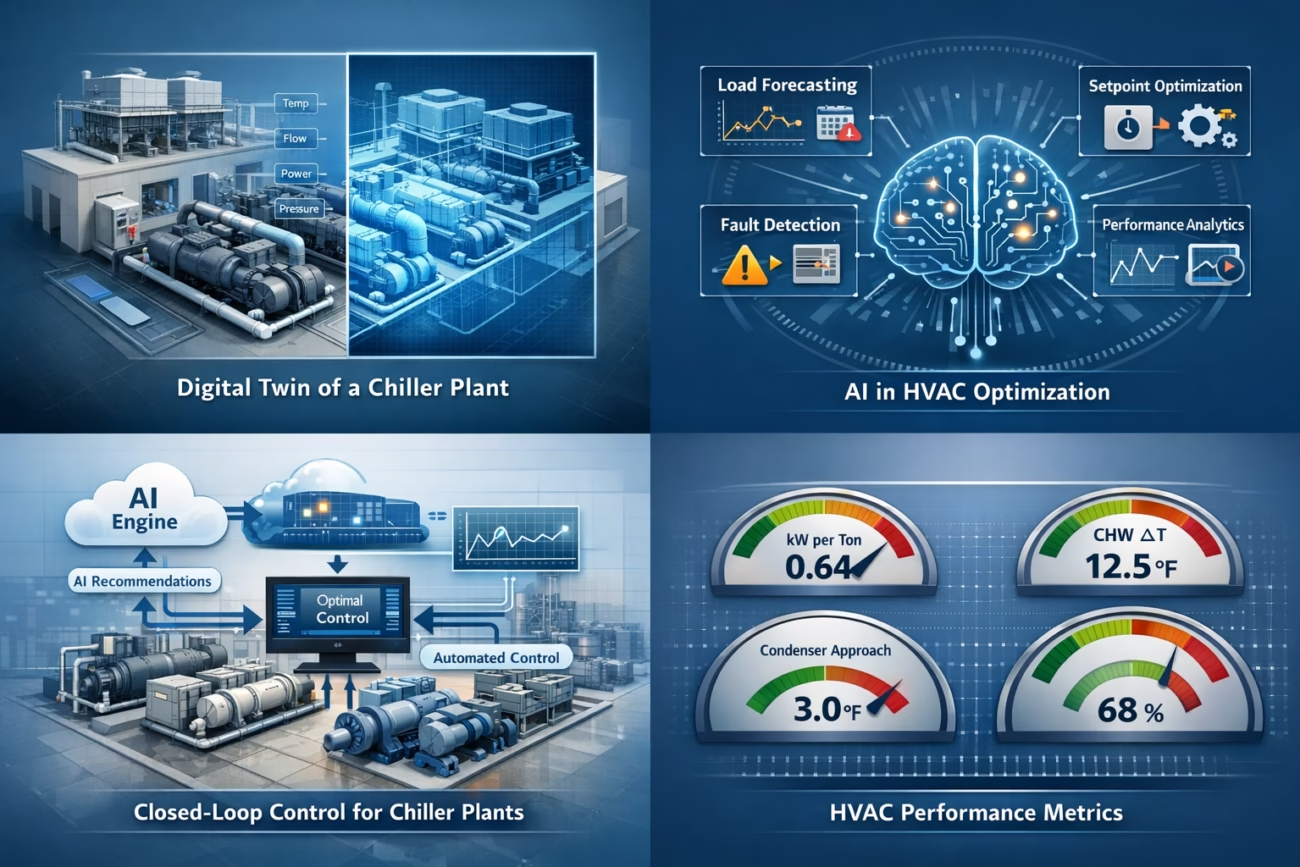
A digital twin for a chiller or HVAC plant is not a 3D visualization or a static dashboard. It is a physics-based, data-driven operational model that reflects how the actual plant is performing in real time.
The twin continuously receives live data from the building management system and field sensors, including temperatures, flow rates, pressures, power consumption, and equipment status. This data is used to mirror the real operating condition of chillers, pumps, cooling towers, valves, and control sequences.
Unlike design models, the digital twin represents actual behavior, including inefficiencies caused by part-load operation, fouling, sensor drift, and control overrides.

⚡ Enjoying this article? Stay updated with weekly HVAC & Energy Hacks — straight on WhatsApp!
💚 Join Our WhatsApp ChannelWhy Chiller and HVAC Plants Need This Approach
HVAC systems typically account for 40 to 50 percent of total building energy consumption, with chiller plants often being the single largest electrical load in commercial and institutional facilities.
Optimization is difficult because plant performance depends on many interacting variables:
- Outdoor weather conditions
- Building occupancy and load variation
- Equipment aging and fouling
- Control logic and sequencing
- Utility demand patterns
Manual tuning and static sequences cannot continuously adapt to these conditions. As a result, plants often operate far from their optimal efficiency point, even when the equipment itself is in good condition.
The Role of AI in a Digital Twin Environment
Artificial intelligence enhances a digital twin by adding prediction and decision-support capabilities, but it does not replace control logic or safety systems.
Where AI Adds Value
- Load forecasting: Short-term prediction of cooling demand improves chiller staging and avoids inefficient low-load operation.
- Setpoint optimization: AI evaluates chilled water and condenser water temperature reset strategies within defined limits.
- Performance degradation detection: Gradual losses due to fouling, approach temperature drift, or sensor bias are identified early.
- Operational recommendations: AI suggests optimal equipment combinations based on efficiency, availability, and constraints.
What AI Does Not Do
- It does not override OEM safety limits
- It does not replace PID control or protection logic
- It does not eliminate the need for engineering validation
Prediction alone does not save energy. Energy savings occur only when validated recommendations are converted into controlled actions.
Closed-Loop Optimization: Where Savings Actually Come From
Many digital twin projects stop at monitoring and dashboards. These provide visibility but limited savings.
Measured improvements occur when:
- AI recommendations are constrained by physics and OEM limits
- Control actions are executed through the BMS
- Performance is continuously verified
Typical control actions include:
- Dynamic chiller sequencing
- Adaptive condenser water temperature reset
- Pump speed optimization using affinity laws
- Cooling tower fan staging
Performance is evaluated using engineering KPIs, such as:
- Plant kW per ton
- Chilled water delta T stability
- Condenser approach temperature
- Part-load chiller efficiency
Realistic energy savings from chiller plant optimization typically range from 8 to 15 percent, depending on baseline operation and data quality. Higher savings are possible only in poorly operated plants or when combined with hardware upgrades.
Why Many HVAC Digital Twin Projects Fail
Common reasons include:
- Inaccurate or missing flow and temperature measurements
- Poor BMS point mapping
- AI models trained once and not maintained
- No clear ownership between operations and energy teams
- Systems limited to advisory mode with no control authority
A digital twin without the ability to influence control decisions becomes a monitoring tool rather than an optimization system.
What Implementation Looks Like in Practice
Most successful projects follow a phased approach:
- Select a single chiller plant or subsystem
- Validate sensor accuracy and data reliability
- Build a physics-based operational model
- Introduce AI for forecasting and diagnostics
- Run in advisory mode with engineering validation
- Enable closed-loop control with limits and override
Critical safety and protection loops remain local at the BMS level, while cloud-based AI operates as an optimization layer—not as a safety controller.
The Role of Cloud and IoT—With Limits
Cloud platforms enable scalable computation and access to external data such as weather forecasts and utility tariffs. However:
- Control latency must be managed
- Cybersecurity must be addressed
- Local fallback operation must be ensured
Cloud intelligence supports optimization, but plant safety and reliability remain on-site responsibilities.
Looking Ahead
Digital twins and AI are becoming practical tools for improving HVAC plant performance, particularly as energy costs rise and carbon targets tighten. Their value lies not in automation for its own sake, but in enabling engineers to operate systems closer to their true efficiency limits.
Final Takeaway
Digital twins and AI do not save energy on their own.
Correct control decisions on live chiller plants do.
For organizations serious about reducing operating costs and improving HVAC performance, digital twin–based optimization—grounded in physics and control theory—is no longer experimental. It is an emerging best practice

Most chiller plants don’t waste energy because of their bad operations.
AI and Digital twin will change the game.