
The condenser in a chiller rarely gets attention until the power bill rises, the compressor starts struggling, or the cooling capacity begins falling short. In many plants, the chiller appears to be “running normally” while silently consuming far more power than it should.
One of the most effective ways to detect this hidden efficiency loss is through LMTD: the Logarithmic Mean Temperature Difference.
For most engineers, LMTD remains a textbook formula used during heat exchanger design. In reality, it is also a powerful field diagnostic tool that can reveal condenser fouling, cooling tower degradation, poor water flow, refrigerant-side problems, and rising compressor energy consumption long before alarms appear.
What the condenser is actually doing
The condenser’s job is simple:
- Remove heat absorbed from the building or process
- Reject compressor heat
- Transfer that heat to cooling water or ambient air
In a water-cooled chiller, cooling tower water absorbs this heat through the condenser tubes.
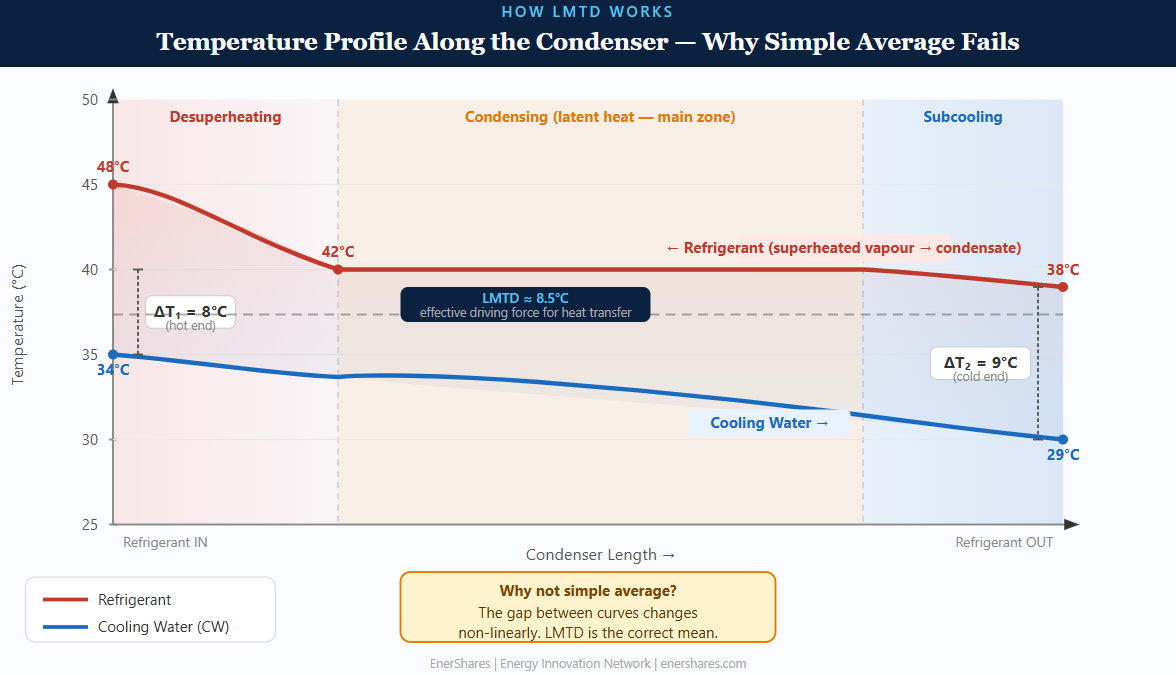
But heat transfer inside a condenser does not occur at one constant temperature.
The refrigerant:
- enters as high-temperature vapour
- desuperheats
- condenses
- sometimes subcools before leaving
Meanwhile, cooling water:
- enters colder
- absorbs heat continuously
- exits warmer
Because both fluids change temperature along the heat exchanger length, the temperature difference between them is never constant.
That changing temperature difference is why simple averaging becomes inaccurate.
LMTD gives the true effective temperature driving force for heat transfer.
The LMTD equation
Where:
- ΔT₁ = temperature difference at one end
- ΔT₂ = temperature difference at the other end
The logarithmic relationship exists because temperature difference changes exponentially across the heat exchanger length, not linearly.
LMTD is therefore not just an “average temperature difference.”
It is the mathematically correct mean temperature difference responsible for actual heat transfer.
Why LMTD matters in a condenser
The condenser follows the basic heat transfer relationship:
Where:
- Q = heat rejected
- U = overall heat transfer coefficient
- A = heat transfer area
- ΔTlm = logarithmic mean temperature difference
In an operating condenser:
- Q is largely determined by the cooling load
- A is fixed by condenser size
That leaves only:
- U
- LMTD
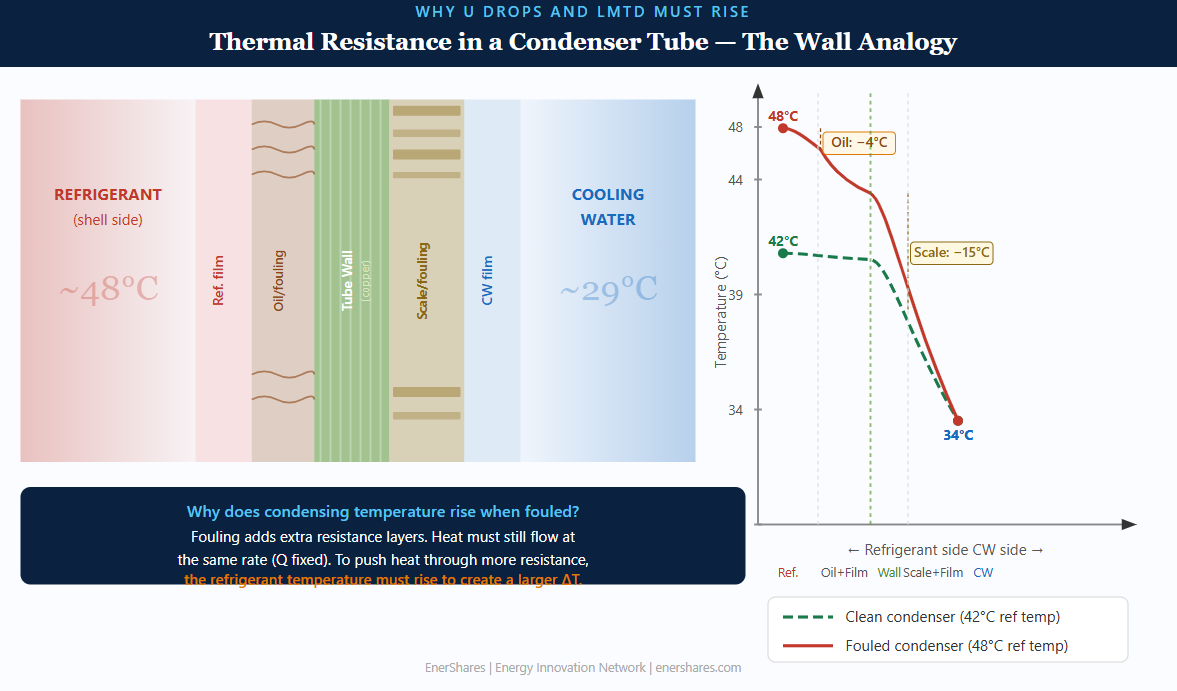
When the condenser becomes dirty or heat transfer deteriorates, U decreases.
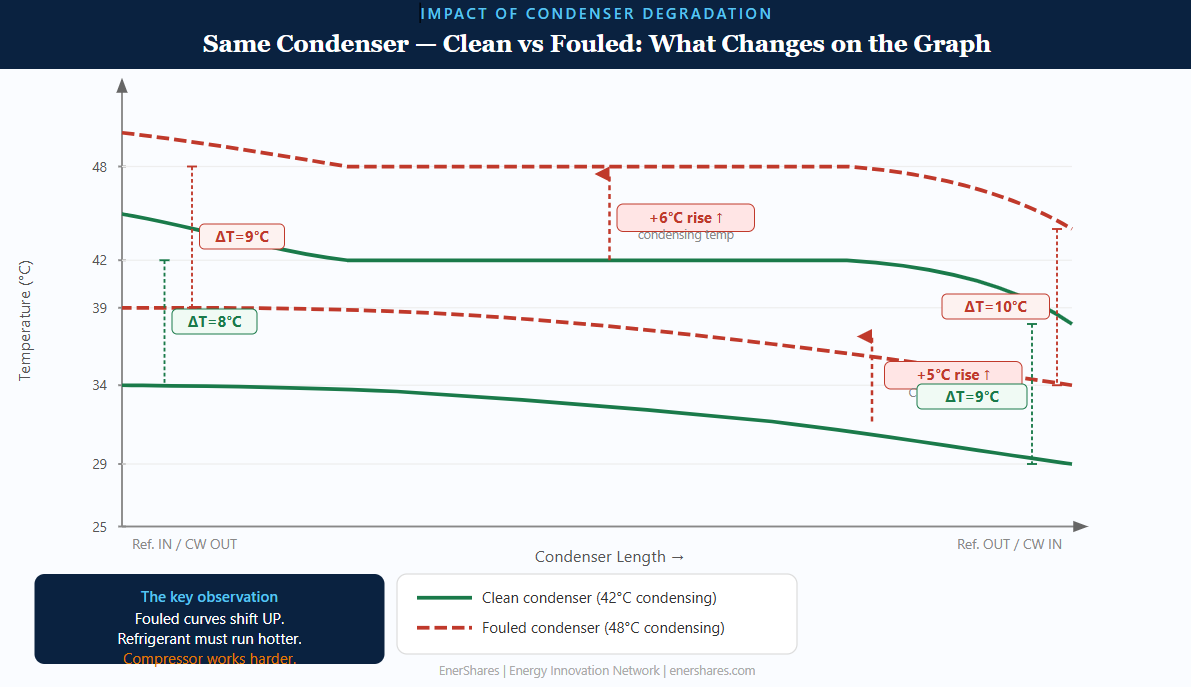
To maintain the same heat rejection, the system compensates by increasing condensing temperature, which forces LMTD higher.
That compensation comes at the cost of compressor energy.
A practical condenser example
Clean condenser condition
Assume:
- Refrigerant condensing temperature = 42°C
- Refrigerant outlet temperature = 38°C
- Cooling water inlet = 29°C
- Cooling water outlet = 34°C
Temperature differences:
- Hot end: 42 − 34 = 8°C
- Cold end: 38 − 29 = 9°C
LMTD becomes approximately:
8.5°C
Under these conditions:
- condensing pressure remains controlled
- compressor lift stays lower
- kW/TR remains near design
What happens when the condenser degrades
Now assume:
- Cooling tower performance worsens
- tubes become fouled
- cooling water enters at 34°C instead of 29°C
To reject the same heat, refrigerant condensing temperature rises:
- Refrigerant condensing temperature = 48°C
- Refrigerant outlet temperature = 44°C
- Cooling water inlet = 34°C
- Cooling water outlet = 39°C
Temperature differences:
- Hot end: 48 − 39 = 9°C
- Cold end: 44 − 34 = 10°C
LMTD now becomes approximately:
9.5°C
At first glance, the higher LMTD appears beneficial.
But this is where many engineers misinterpret condenser behaviour.
The condenser did not become more efficient.
The refrigerant temperature had to rise significantly to compensate for degraded heat transfer. That means:
- higher condensing pressure
- higher compressor compression ratio
- higher motor power consumption
The compressor is effectively paying the penalty for poor condenser performance.
Why rising condensing temperature matters
Every increase in condensing temperature directly increases compressor power consumption.
Typical impact:
- roughly *2–3% additional compressor power per 1°C rise in condensing temperature.
“The actual impact on specific power in a real plant reflects not just condensing temperature but also CT degradation, reduced CW flow, and combined system effects — often exceeding the simple rule of thumb.”
Example:
| Condition | Clean Condenser | Fouled Condenser |
|---|---|---|
| CW Inlet Temperature | 29°C | 34°C |
| Condensing Temperature | 42°C | 48°C |
| LMTD | 8.5°C | 9.5°C |
| Specific Power | 0.62 kW/TR | 0.84 kW/TR |
That increase may appear small numerically.
But on a 500 TR plant operating 6,000 hours annually, the additional energy consumption becomes extremely significant.
Condenser approach temperature
Another important indicator is condenser approach temperature:
Condensing Temperature − Cooling Water Leaving Temperature
A rising approach temperature generally indicates:
- tube fouling
- scaling
- poor water flow
- air accumulation
- reduced heat transfer effectiveness
LMTD and approach temperature together provide a very powerful picture of condenser health.
What reduces heat transfer coefficient (U)
Several field problems reduce condenser heat transfer efficiency:
| Issue | Typical Cause | Effect |
|---|---|---|
| Waterside scaling | Poor cooling tower water treatment | Lower heat transfer |
| Biological fouling | High TDS or inadequate blowdown | Increased thermal resistance |
| Oil logging | Compressor oil migration | Insulating layer on tubes |
| Non-condensable gases | Air ingress after maintenance | Higher condensing pressure |
| Low cooling water velocity | Pump degradation or valve issues | Reduced convection |
| Tube corrosion | Improper chemistry control | Reduced conductivity |
As U decreases, condensing temperature must rise to maintain heat rejection.
LMTD as a field diagnostic tool
LMTD is extremely useful during energy audits and troubleshooting.
Basic workflow:
- Measure cooling water inlet temperature
- Measure cooling water outlet temperature
- Read condensing temperature from the chiller
- Calculate ΔT₁ and ΔT₂
- Compute LMTD
- Compare against baseline values at similar loading conditions
A rising LMTD at comparable load usually indicates condenser degradation.
This helps separate:
- condenser issues
- cooling tower problems
- refrigerant-side abnormalities
- compressor-related faults
Cooling tower connection
The cooling tower and condenser always operate together.
If cooling tower performance drops:
- cooling water enters warmer
- condenser heat rejection becomes more difficult
- condensing temperature rises
- compressor power increases
Typical reasons:
- blocked fill
- improper fan operation
- poor water distribution
- incorrect chemical treatment
- high approach temperature
LMTD trends often help determine whether the issue originates in:
- the condenser
- the cooling tower
- or the refrigerant circuit
What many audits miss
Many chiller audits focus only on:
- compressor efficiency
- COP
- VFD performance
- part-load curves
But the compressor is heavily influenced by condenser conditions.
If condenser performance is ignored, the analysis becomes incomplete.
A chiller can have:
- healthy compressor operation
- normal pressures
- no alarms
and still waste massive amounts of energy due to degraded heat transfer.
That is why condenser LMTD should be tracked in:
- HVAC performance studies
- energy audits
- IPMVP-based M&V
- ISO 50001 monitoring programs
Key Takeaways
- LMTD represents the true effective temperature driving force for condenser heat transfer.
- A drop in heat transfer coefficient forces condensing temperature to rise, increasing compressor power consumption.
- A higher operating LMTD is not always a good sign. It may indicate degraded condenser performance.
- LMTD helps diagnose:
- tube fouling
- cooling tower degradation
- poor water flow
- refrigerant-side issues
- Tracking LMTD can identify hidden chiller energy losses long before major failures occur.
Final thought
Many chillers continue operating for years with elevated condensing temperatures while nobody notices the energy penalty being paid every hour.
The machine still cools.
The compressor still runs.
The alarms stay silent.
But the condenser slowly pushes the entire system away from design efficiency.
LMTD is often the first number that reveals it.
⚡ Enjoying this article? Stay updated with weekly HVAC & Energy Hacks — straight on WhatsApp!
