
Modern BMS platforms do far more than control equipment. They provide portfolio-level visibility, real-time diagnostics, energy insights, alarm intelligence, scheduling automation, and healthy-building analytics. When applied to AHUs, these capabilities dramatically improve performance, reliability, and operating cost.
This section captures the essential features seen across next-generation BMS tools — rewritten in a clean, engineering-neutral format suitable for your blog.
⚡ Enjoying this article? Stay updated with weekly HVAC & Energy Hacks — straight on WhatsApp!
💚 Join Our WhatsApp Channel1. Portfolio-Level Monitoring and Multi-Site Visibility
Modern BMS dashboards allow operators to view the health of all buildings under their portfolio in one screen.
Typical insights include:
- Sites with active alarms
- Comfort performance (temperature/humidity/CO₂ deviation)
- Excess energy usage
- Equipment operating out of schedule
- Offline devices or communication issues
This helps facility teams prioritise which site needs attention first, reducing travel time and improving resolution speed.
2. Site-Level Summary for AHU Performance
Each building or site usually has its own performance dashboard showing:
Connectivity Health
- Controllers, gateways, and sensors online/offline status
- Communication reliability
Comfort Indicators
A combined score derived from:
- Temperature deviation
- Humidity deviation
- CO₂ levels
A high comfort score implies the AHUs are maintaining environmental conditions effectively.
Energy Indicators
- Excessive fan runtimes
- Manual overrides
- Extended operation outside schedule
- Abnormal setpoint changes
These insights help identify wasted energy due to poor AHU operation.
Alarm Summary
- Number of alarms by severity (High/Medium/Low)
- Frequently repeating alarms
- Equipment-level fault patterns
This prevents missing critical issues like freeze-stat trips, DP rise across filters, or damper failures.
3. Equipment-Level Diagnostics (Digital Twin for AHU)
Modern BMS allows engineers to open an AHU and view everything in a structured “equipment detail view”:
- SAT, RAT, MAT temperatures
- Static pressure
- Fan speed (VFD Hz)
- CHW/HW supply & return
- Filter DP
- Damper positions
- Valve positions
- Humidity
- Real-time alarms
- Trend charts (24 hours / 7 days / 30 days)
Operators can also modify:
- Setpoints
- Schedules
- Safety thresholds
- Manual/Auto states
- Overrides for testing
This becomes a digital twin, enabling troubleshooting without being physically present at the plant room.
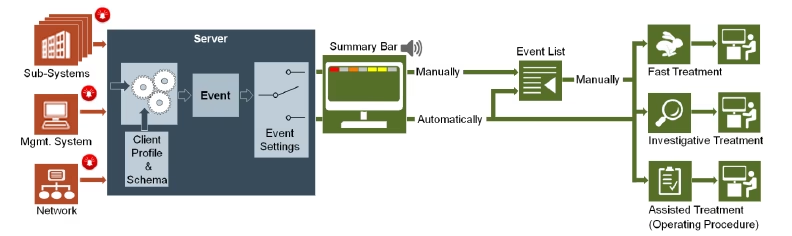
4. Intelligent Alarms and Priority-Based Handling
Good BMS platforms use priority-based alarm systems so operators don’t get flooded.
Critical Alarms (Immediate Shutdown)
- Freeze-stat trip
- Smoke detection
- High duct pressure
- Fan/pump failure
High-Priority Alarms
- Filter DP high
- Low mixed-air temperature
- Damper failure
- Coil temperature out of range
Medium Priority
- Sensor failure
- Communication loss
- CHW/HW temperature deviation
Low Priority
- Maintenance reminders
- Minor deviations
This helps the operator focus on failures that directly impact AHU performance or safety.
5. Central Scheduling and Holiday Management
Modern scheduling engines allow:
- Weekly operating schedules
- Special events (maintenance, shutdowns)
- Holiday exceptions
- Temporary overrides
This ensures AHUs operate only when needed:
- Occupied mode during business hours
- Setback or OFF mode at nights/weekends
- Strict protection against manual overrides that increase energy use
Correct scheduling alone can reduce AHU energy consumption by 15–25%.
6. Energy Insights for AHU Optimization
BMS analytics compare actual AHU performance against expected behaviour and highlight inefficiencies:
- Excessive VFD speed
- Wrong static pressure setpoint
- High runtime alarms
- Low CHW ΔT
- High DP across filters
- Heat/cool conflict
- Abnormal temperature patterns
These insights help engineers detect issues earlier and reduce operating cost.
7. Trend Logs (Most Powerful Diagnostic Tool)
Trend logging is essential for understanding AHU behaviour over time.
Key parameters to trend:
- SAT, MAT, RAT
- Static pressure
- VFD speed
- CHW and HW valve modulation
- Filter DP trends
- Humidity
- Damper position
- CHW/HW temperature and ΔT
Trend logs help catch:
- Valve hunting
- Sensor drift
- Filter clogging long before alarms
- Coil freezing risks
- Damper leakage
- Wrong scheduling
- Unstable PID tuning
This converts AHU diagnostics from guesswork to data-driven decision-making.
8. Healthy-Building Indicators
Modern BMS platforms combine sensor inputs to calculate an Indoor Air Quality (IAQ) score or Healthy Building rating, typically based on:
- Temperature
- Humidity
- CO₂
- PM2.5
- VOCs
AHUs play a central role in maintaining IAQ by controlling:
- Fresh air intake
- Filtration efficiency
- Humidity regulation
- Pressure balance in zones
This helps organizations maintain healthy and compliant indoor environments.
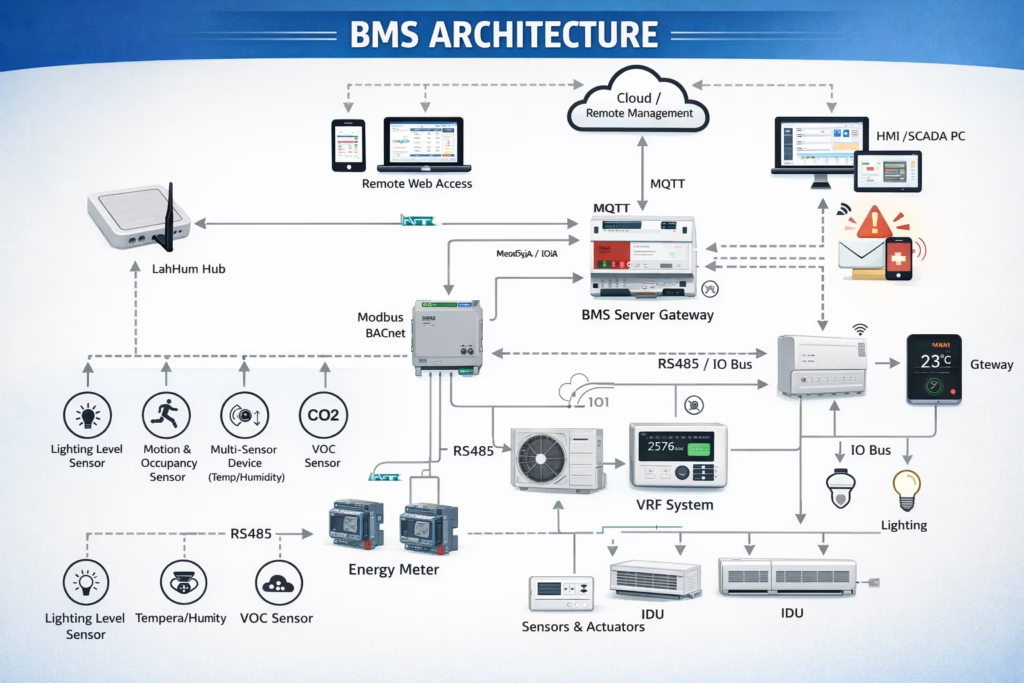
9. Modern Connectivity Architecture
A typical BMS architecture powering AHU monitoring includes:
- Field sensors (temperature, humidity, CO₂, DP, VOC)
- AHU controller (DDC/PLC managing all loops & interlocks)
- IoT gateway (aggregating data)
- Cloud BMS platform (analytics, dashboards, alarms, scheduling)
- Mobile or web clients (remote access)
This architecture ensures:
- Anytime, anywhere monitoring
- Multi-site management
- Predictive maintenance
- Standardised reporting
- Secure remote access

Excellent Read.
request you can add real life scenarios as a step forward.
Thank you for sharing this.