
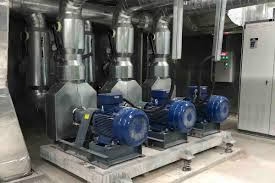
What Actually Works, What Fails, and Why Most Plants Get It Wrong
In chilled water systems, pump configuration is rarely the problem on paper.
In reality, it is one of the largest hidden energy losses in HVAC plants.
Most systems use multiple pumps, but very few operate them in a way that matches the system resistance, load variation, and control logic. The result is excess power consumption, poor delta T, and unstable operation—often without anyone realizing the root cause.
This article explains series and parallel pump operation from a real HVAC plant perspective.
Understanding the Basics
Parallel Pump Operation
- Pumps share common suction and discharge headers
- Flow increases
- Head remains nearly the same
At any given head, flows add.
This is why parallel pumps are used in most chilled water plants.
Series Pump Operation
- Discharge of one pump feeds into the suction of the next
- Head increases
- Flow remains nearly the same
At the same flow, heads add.
This configuration exists only to overcome high system resistance.
Why Parallel Pumps Dominate Chilled Water Systems
Most HVAC chilled water systems are variable load systems:
- Cooling demand changes hourly
- Flow requirement reduces at part load
- Static head is fixed, but frictional losses change
Parallel pumps make sense because they allow:
- Pump staging (run only what is needed)
- High part-load efficiency
- Operational redundancy
- Smaller motors instead of one oversized pump
⚡ Enjoying this article? Stay updated with weekly Chiller, HVAC & Energy Hacks — straight on WhatsApp!
💚 Join Our WhatsApp ChannelReality Check
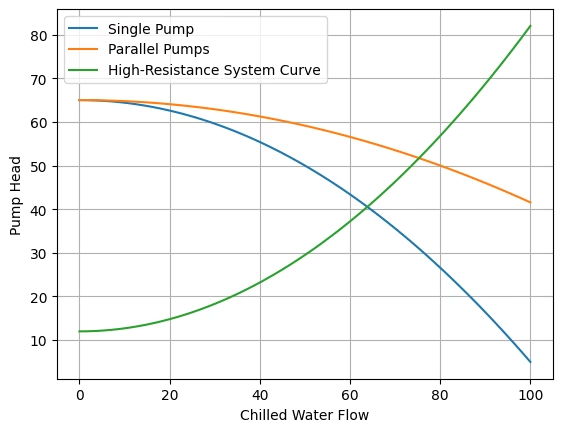
“Two pumps in parallel will double the flow.”
In one pharma plant I audited, adding a third parallel pump increased power by 18% while flow went up only 9%—purely because the system curve was steep.
This is only true near free delivery, not at the actual operating point.
As system resistance increases, the incremental flow gain drops sharply. In high-resistance systems, adding parallel pumps gives very little benefit and often increases power consumption.
When Parallel Pumps Fail in Real Plants
From field audits, parallel pumps underperform when:
- The system curve is steep (high resistance)
- All pumps run continuously at low speed
- Differential pressure (DP) setpoint is fixed year-round
- DP sensor is placed near the pump instead of the index circuit
- Minimum VFD speed is locked too high
Typical Site Symptom
- 2 or 3 pumps running
- Each at 30–40% speed
- Delta T collapsing
- kW per TR increasing
This is not a pump efficiency issue.
This is a system configuration and control problem.
Where Series Pump Operation Makes Sense
Series pumps should only be considered when:
- Static head requirement is very high
(tall buildings, deep basements, roof-mounted equipment) - Long distribution networks (campus or district cooling)
- A single pump cannot meet head requirements economically
Example Applications
- Basement primary pump + roof booster pump
- High-rise buildings with zoning pressure limits
Why Series Pumps Are Avoided in HVAC
- Poor flexibility at part load
- Limited energy optimization
- Higher risk of mismatch and instability
- Difficult control coordination
Using series pumps to “fix” flow problems is a design shortcut, not a solution.
The Stability Problem Nobody Talks About
Both series and parallel pump combinations have unstable operating regions.
These occur when:
- Pump curves intersect system curves at unfavorable points
- Pumps are mismatched
- Control logic is aggressive or poorly tuned
Symptoms include:
- Hunting
- Frequent pump staging
- Noise and vibration
- Unexplained alarms
Instability is not predictable from nameplate data.
It shows up only when pump curves, system curves, and controls interact.
What We Actually Check During an ESO
During an Energy Saving Opportunity assessment, we do not start with pump efficiency.
We start with:
- System curve behavior
- Pump operating points at different loads
- Staging logic and sequence
- DP reset strategy
- Real operating hours per pump
Very often, no pump replacement is required.
Optimization alone delivers measurable savings.
Final Engineering Takeaway
- Parallel pumps are correct for most chilled water systems
- Series pumps are niche solutions for high static head only
- Energy waste comes from wrong assumptions, not wrong pumps
- If multiple pumps run most of the time, something is misaligned
Pump selection gets attention.
Pump operation decides energy performance.
When to Revisit Your Pump Configuration
- Delta T is consistently low
- More pumps run than expected
- Power does not reduce at part load
- Flow complaints despite adequate installed capacity
These are system signals—not equipment failures.
This is exactly the type of issue addressed during Energy Saving Opportunity studies.
Correcting pump configuration and control logic often delivers faster ROI than hardware changes.
Seeing more than one chilled water pump running below 45 Hz most of the time?
Share your plant basics and I’ll tell you in 5 minutes whether pump reconfiguration or DP reset can save you ~$10k–18k per year—without changing hardware.
