
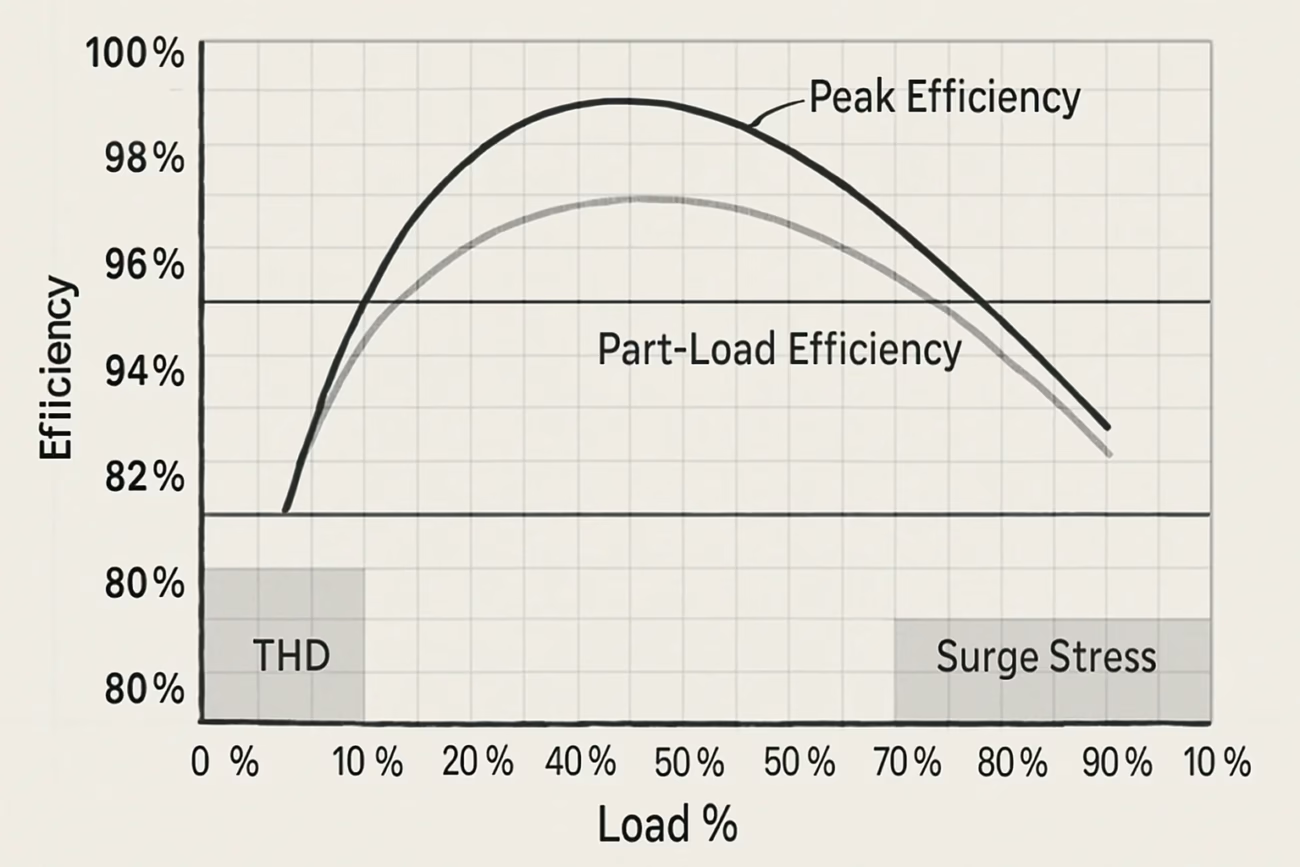
Understanding Part-Load Performance and AHRI 550/590 Standards
Figure 1: IPLV Quick Reference Guide
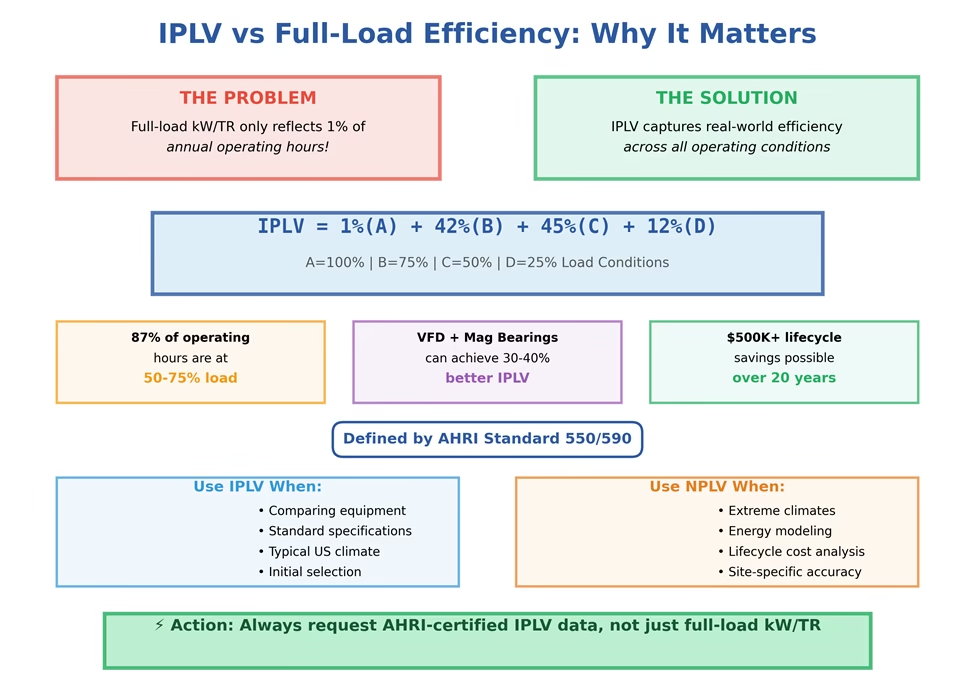
When it comes to evaluating HVAC equipment efficiency, most people instinctively look at the kilowatt per ton ratio (kW/TR). It’s a simple, straightforward metric that seems to tell you everything you need to know about how efficiently your chiller or heat pump operates. But here’s the problem: relying solely on full-load kW/TR is like judging a car’s fuel efficiency based only on highway driving, it completely ignores how the equipment performs in real-world conditions.
This is where the Integrated Part Load Value, or IPLV, comes into play. Defined by AHRI Standard 550/590, IPLV is the industry-recognized metric for evaluating real-world chiller efficiency. Understanding IPLV is crucial for anyone involved in HVAC design, energy management, or building operations. Let’s dive deep into what IPLV really means and why it should be your go-to metric for evaluating cooling equipment.
The Problem with kW/TR as Your Only Metric
The kW/TR rating tells you how many kilowatts of electricity your equipment consumes per ton of cooling it provides. Sounds useful, right? It is, but only under very specific conditions.
Here’s the catch: kW/TR is calculated at 100% capacity under design conditions. These design conditions represent the absolute worst-case scenario. The hottest day of the year, maximum humidity, peak occupancy, all systems running at full blast. In most climates, these conditions might occur for only 1% of the year, or roughly 87 hours out of 8,760.
For the remaining 99% of operating time, your equipment is running at partial loads anywhere from 25% to 75% of its capacity. And here’s the crucial insight: efficiency at full load doesn’t predict efficiency at partial load. Some equipment that looks great on paper at 100% capacity performs poorly when throttled down. Others particularly those with variable speed drives and magnetic bearing technology excel at part-load operation, delivering significant energy savings during those thousands of hours of typical operation.
What Exactly Is IPLV? Understanding AHRI 550/590
The Integrated Part Load Value is defined by the Air-Conditioning, Heating, and Refrigeration Institute (AHRI) in their Standard 550/590 for water-cooled and air-cooled chillers. Rather than looking at just one operating point, IPLV provides a weighted average of efficiency across four different load conditions that represent typical commercial building operation:
| Load Point | % Capacity | Weighting | ECWT (°F) |
| A (Full Load) | 100% | 1% | 85°F |
| B | 75% | 42% | 75°F |
| C | 50% | 45% | 65°F |
| D | 25% | 12% | 65°F |
Note: ECWT = Entering Condenser Water Temperature for water-cooled chillers
IPLV testing conditions also vary condenser entering water temperature (or outdoor ambient for air-cooled units) to simulate seasonal variation. This is critical: IPLV reflects not only how the chiller responds to reduced cooling load, but also how it takes advantage of improved heat rejection conditions during part load operation. As ambient temperatures drop in spring and fall, cooling towers can deliver colder condenser water, allowing the chiller to operate more efficiently.
The IPLV formula combines these four points using the efficiency (COP or EER) at each load condition:
IPLV = 0.01(A) + 0.42(B) + 0.45(C) + 0.12(D)
These diagrams reveal several critical insights: the pie chart shows that 87% of operating time occurs at 50-75% load; the efficiency curves demonstrate how VFD-equipped chillers dramatically outperform traditional units at part load; the operating hours bar chart quantifies the massive time spent in part-load conditions; the daily load profile shows typical building operation; the lifecycle cost comparison proves the financial impact; and the technology comparison illustrates why modern compressor designs achieve superior IPLV ratings.
Figure 2: Comprehensive IPLV Analysis – Six Key Perspectives
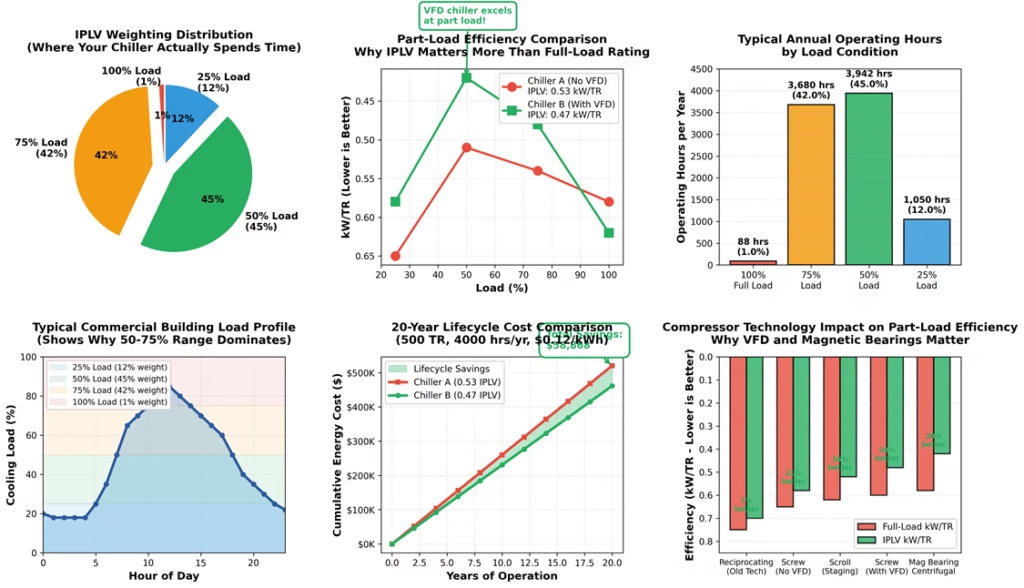
The following comprehensive diagrams illustrate why IPLV is critical for real-world efficiency evaluation:
Visual Analysis: Understanding IPLV Through Data
where A, B, C, D represent EER or COP values at each load point
Notice how the formula heavily weights the 50% and 75% load points (totaling 87%) that’s because this standardized weighting is based on actual load distribution data from typical U.S. commercial buildings. The full-load condition gets only 1% weighting because peak design conditions are so rare in actual operation. These percentages represent a conceptual distribution of operating hours, not guaranteed runtime, but they reflect decades of building energy research.
IPLV vs NPLV: Understanding the Difference
While IPLV uses standardized AHRI test conditions, real projects often require evaluation at actual site conditions. This is where Non-Standard Part Load Value (NPLV) comes into play.
| Aspect | IPLV | NPLV |
| Test Conditions | Fixed AHRI 550/590 standard conditions | Actual project-specific site conditions |
| Purpose | Apples-to-apples equipment comparison | Accurate performance prediction for specific project |
| When to Use | Initial equipment selection and specification | Energy modeling, lifecycle cost analysis, extreme climates |
| Example | 85°F entering condenser water at 100% load | 95°F ECWT in Phoenix or 75°F in Seattle |
For projects in extreme climates whether desert heat in Phoenix or cool marine conditions in Seattle requesting NPLV calculations at actual site conditions provides much more accurate energy consumption predictions than relying solely on standardized IPLV.
Why IPLV Varies: The Impact of Compressor Technology
Not all chillers are created equal when it comes to part-load performance. The compressor technology and control strategy have enormous influence on IPLV:
Magnetic Bearing Centrifugal Chillers with VFD: These represent the pinnacle of part-load efficiency. Variable frequency drives (VFDs) allow the compressor to slow down at reduced loads. Thanks to the affinity laws, power consumption drops with the cube of speed reduction. A 50% speed reduction results in only 12.5% of full-load power. Combined with frictionless magnetic bearings and improved heat rejection at lower ambient temperatures, these chillers can achieve remarkable IPLV values often 30-40% better than their full-load rating.
Screw Chillers without VFD: Traditional screw compressors using slide valve capacity control see more modest part-load gains. While they do become more efficient at reduced loads, the improvement is less dramatic. Their IPLV might be only 10-15% better than full-load efficiency.
Scroll Chillers with Multi-Compressor Design: These units achieve part-load efficiency through staging turning compressors on and off. While effective, they operate in steps rather than continuously variable capacity, resulting in IPLV improvements of 15-20% over full-load performance.
Reciprocating Chillers: Older reciprocating technology typically shows the least part-load improvement, as cylinder unloading is less efficient than other modulation methods.
This technology impact explains why two chillers with similar full-load efficiency can have dramatically different IPLV ratings. When evaluating bids, always look at both metrics to understand the complete efficiency picture.
Understanding IPLV Limitations
While IPLV is far superior to relying solely on full-load efficiency, it’s important to understand its limitations.
One limitation is that IPLV uses standardized weighting factors based on a typical commercial building load distribution defined in AHRI 550/590. Actual operating profiles can differ significantly. For example, a data center or process facility may operate closer to higher load conditions, while office buildings may spend more time below 50 percent capacity. In such cases, IPLV may not accurately represent real annual performance.
Standardized Weighting May Not Match Your Building
One limitation is that IPLV uses standardized weighting factors based on a typical commercial building load distribution defined in AHRI 550/590. Actual operating profiles can differ significantly. For example, a data center or process facility may operate closer to higher load conditions, while office buildings may spend more time below 50 percent capacity. In such cases, IPLV may not accurately represent real annual performance.
The Four-Point Limitation
IPLV only captures four snapshots of performance: 100%, 75%, 50%, and 25%. But what happens at 60% load? Or 40%? Or 85%? Modern variable-speed equipment can operate across a continuous spectrum of loads, and efficiency can vary significantly between these measured points. This is where detailed energy modeling becomes valuable for critical projects.
The Sweet Spot: Where Most Equipment Actually Operates
Here’s a critical insight that every HVAC professional should understand: most commercial HVAC equipment operates in the 50% to 75% capacity range for the vast majority of its runtime.
Why? Because HVAC systems are typically designed with safety margins. Engineers don’t design for average conditions they design for peak conditions, then add 10-20% capacity as a buffer. This means that under normal operating conditions, the equipment is inherently running at partial load.
Add to this the natural variations in weather, occupancy, and internal heat loads throughout the day and across seasons, and you’ll find that hitting 100% capacity is actually quite rare. Even on hot days, you’re more likely to see 70-85% load during peak hours, dropping to 30-50% during shoulder hours.
This is precisely why IPLV’s weighting scheme makes sense—it recognizes this reality and gives the most importance to the load ranges where equipment actually spends its time.
Going Beyond IPLV: Custom Load Profiles and Energy Modeling
For critical projects or large installations, the smart move is to develop a building-specific load profile through detailed energy modeling. This involves analyzing:
Climate data: Hourly temperature and humidity data for your location over a typical meteorological year (TMY3 data).
Building schedules: Occupancy patterns, operating hours, and seasonal variations.
Internal loads: Lighting, plug loads, process equipment, and how they vary throughout the day.
Heat rejection system performance: How cooling towers, condensers, and heat recovery systems perform across different ambient conditions throughout the year.
With this data, you can create a customized efficiency metric weighted according to how your specific building actually operates. Energy modeling software can simulate 8,760 hours of operation, giving you a true annual energy consumption figure that accounts for your specific conditions. This is the gold standard for equipment selection—but it requires significantly more effort and expertise than simply comparing IPLV numbers from specification sheets.
For rooftop units and other air-cooled equipment, you’ll also encounter IEER (Integrated Energy Efficiency Ratio), which follows a similar concept to IPLV but with different test conditions appropriate for direct-expansion equipment. Understanding these related metrics helps ensure you’re comparing equipment fairly within each category.
Real-World Example: The IPLV Advantage
Let’s look at a practical comparison between two 500-ton chillers to see why IPLV matters. To understand how these efficiency values translate to actual IPLV ratings, we need to calculate using the COP (Coefficient of Performance) at each load point:
| Load | Chiller A | Chiller B | Weighting | Impact |
| 100% | 0.58 kW/TR | 0.62 kW/TR | 1% | Minimal |
| 75% | 0.54 kW/TR | 0.48 kW/TR | 42% | HIGH |
| 50% | 0.51 kW/TR | 0.42 kW/TR | 45% | HIGHEST |
| 25% | 0.65 kW/TR | 0.58 kW/TR | 12% | Low |
| IPLV | 0.53 kW/TR | 0.47 kW/TR | 100% | — |
At first glance, Chiller A looks better, it has superior full-load efficiency (0.58 vs 0.62 kW/TR). If you were making your decision based solely on the manufacturer’s headline number, you’d choose Chiller A.
But look at what happens when we consider IPLV. Chiller B absolutely dominates at part-load conditions, particularly at 50% and 75% load where the equipment spends 87% of its operating hours. The result? Chiller B has an IPLV of 0.47 kW/TR compared to Chiller A’s 0.53 kW/TR, an 11% improvement in real-world efficiency.
Over a 20-year lifespan, this difference translates to hundreds of thousands of dollars in energy savings (depending on plant size and operating hours) and a significantly smaller carbon footprint. For a 500-ton plant running 4,000 hours per year at $0.12/kWh, this 11% efficiency improvement saves approximately $26,000 annually over $500,000 in lifecycle energy costs.
Practical Takeaways for HVAC Professionals
Always request IPLV data per AHRI 550/590. Don’t just accept the manufacturer’s full-load efficiency number. Ask for the complete part-load performance curve or at minimum, the certified IPLV rating. Reputable manufacturers will have AHRI certification readily available.
Consider NPLV for extreme climates. If your project is in Phoenix, Minneapolis, or other extreme climate zones, request NPLV calculations at actual site conditions for more accurate performance predictions.
Understand the operating profile. Before selecting equipment, take time to understand how your specific building will operate. A laboratory with constant high loads requires different considerations than a school with seasonal closures.
Evaluate compressor technology impact. Pay attention to whether equipment uses magnetic bearings, VFDs, or traditional capacity control. These technologies dramatically affect part-load performance and lifecycle costs.
Consider energy modeling for major projects. For large installations or critical applications, invest in proper energy modeling with 8,760-hour simulation. The insights gained often justify the additional engineering cost many times over through optimized equipment selection.
Look beyond first cost. Equipment with better IPLV ratings often costs more upfront, but the life-cycle cost factoring in 15-20 years of operating expenses frequently favors the more efficient option by a wide margin.
Monitor actual performance. Once equipment is installed, verify that it’s performing as expected across different load conditions. Trending data can reveal if the equipment is actually delivering the part-load efficiency you specified.
The Bottom Line
The transition from using kW/TR to IPLV as your primary efficiency metric represents a fundamental shift in how we think about HVAC equipment performance. It’s a move from theoretical maximum efficiency to real-world operational efficiency from what equipment can do under perfect conditions to what it actually does during thousands of hours of varied operation.
IPLV, as defined by AHRI 550/590, provides a standardized framework for comparing equipment on a realistic basis. While it can’t account for every unique building and climate combination, it’s dramatically better than relying solely on full-load ratings. For projects requiring higher precision, NPLV calculations at actual site conditions bridge the gap between standardized ratings and project-specific performance.
For those willing to invest additional effort, developing building-specific load profiles and conducting detailed energy simulations will always provide the most accurate picture. But even if you never get that deep into the analysis, simply making the shift to evaluating equipment based on IPLV rather than full-load kW/TR will lead to better equipment selections and lower operating costs.
In an era where energy costs continue to rise and sustainability becomes increasingly critical, understanding and using IPLV isn’t just a nice-to-have it’s an essential skill for anyone involved in HVAC system design, specification, or operation. The equipment that looks best on the spec sheet at 100% load might be costing you money every hour it runs at the 50-75% loads where it actually spends its life.
Make IPLV your go-to metric, understand when NPLV is warranted, and you’ll be making decisions based on reality rather than theory which is exactly where energy efficiency needs to be evaluated.
⚡ Enjoyed this article? Stay updated with weekly Chiller, HVAC & Energy Hacks — straight on WhatsApp!
💚 Join Our WhatsApp ChannelUse this tool to calculate Chiller Performance
Use this tool to calculate Chilled water Cost.
