
| Your chiller is running. The cooling is being delivered. There are no alarms. And yet your energy bill is running 40% higher than it should be. This is the silent cost of Low Delta T Syndrome. It does not trip an alarm. It does not stop the system. It quietly erodes efficiency, inflates pumping costs, and forces chillers to operate at part-load and most building operators never detect it. |
| “Low Delta T is not a chiller issue. It is a system-level thermo-hydraulic inefficiency, and it demands a system-level diagnosis.” |
This case study documents a real site observation, explains the engineering mechanism behind Low Delta T Syndrome, and provides a complete 12-step diagnostic and remediation framework developed by EnerShares.
1. Site Observation: A Chiller Plant That Looks Fine-but Isn’t
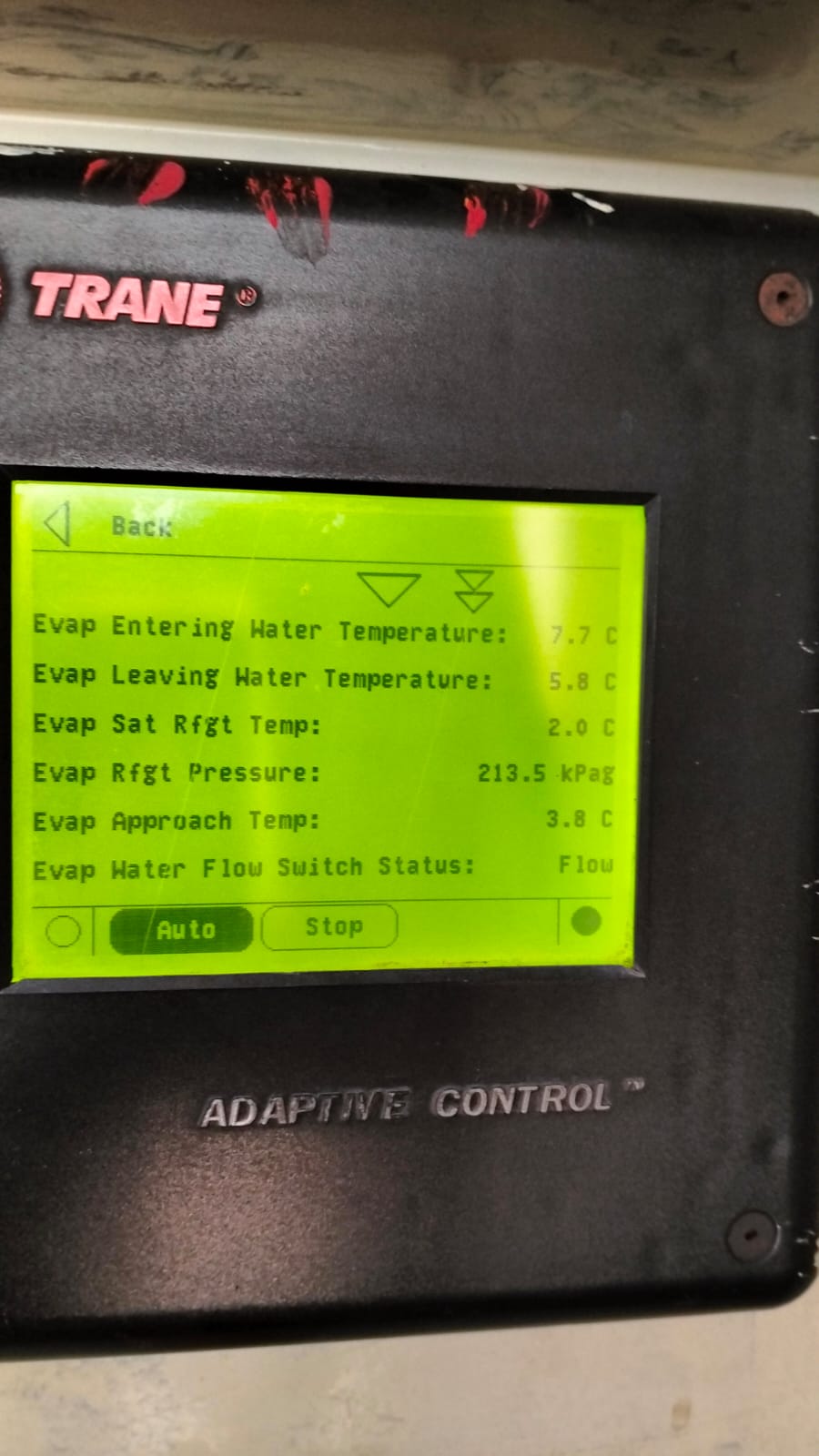
During a routine walkthrough of an occupied commercial building, the following live readings were recorded at the chiller evaporator:
| Parameter | Measured Value | Status |
| Evaporator Entering Water Temperature (CHWR) | 7.7°C | Recorded |
| Evaporator Leaving Water Temperature (CHWS) | 5.8°C | Recorded |
| Measured Delta T (ΔT) | 1.9°C | ⚠ Below design |
At first glance, the site appeared fully operational: cooling was being delivered, occupant comfort was maintained, and no fault codes were active.
The inefficiency was entirely hidden within the hydraulic and thermal performance data.
2. Design vs Actual: The Delta T Gap
Every chiller plant is designed around a specific temperature differential between the supply and return chilled water. This design Delta T determines the flow rate, pump sizing, chiller staging, and the entire hydraulic balance of the system.
| Design Condition | Measured Condition |
| Supply: 7.0°C | Supply: 5.8°C |
| Return: 12.0°C | Return: 7.7°C |
| Delta T: 5.0°C | Delta T: 1.9°C |
| Flow (1,000 TR plant): ~605 m³/hr | Flow (same plant): ~1,590 m³/hr |
| System: Hydraulically balanced | System: Over-pumped, imbalanced |
The design Delta T of 5°C ensures that heat is extracted efficiently from the building with the minimum required flow. When this collapses to 1.9°C, the system must circulate far more water to move the same amount of heat with severe energy consequences.
3. The Engineering Mechanism
The Governing Equation
All chiller plant performance is governed by a single heat transfer relationship:
| Fundamental Heat Transfer Equation Cooling Load (kW) = Mass Flow Rate × Specific Heat (Cp) × Delta T |
For a given cooling load, if Delta T falls, flow must rise proportionally. This is not a design choice it is thermodynamic law. The only way to deliver the same cooling with a lower Delta T is to push more water through the system.
Quantified Impact: 1,000 TR Chiller Plant
| Condition | Delta T | Chilled Water Flow | Pump Energy |
| Design Condition | 5.0°C | ~605 m³/hr | Baseline (1×) |
| Actual (Low ΔT) | 1.9°C | ~1,590 m³/hr | ~2.5× higher |
At 1.9°C Delta T, the system is circulating over 1,590 m³/hr instead of the design 605 m³/hr. Since pump power scales with the cube of flow speed, this represents a catastrophic energy penalty far exceeding what the flow ratio alone suggests.
4. System-Wide Impact
| System Area | Impact of Low ΔT | Severity |
| Pump System | Flow increases ~2.5×; pump energy rises proportionally | High |
| Chillers | Reduced COP; multiple chillers run unnecessarily at part load | High |
| AHU Performance | Flow imbalance; some zones over-served, others starved | Medium |
| Controls | Demand-based sequencing becomes unreliable | Medium |
| Overall Plant Energy | 15–25% increase in total plant kWh is typical | Critical |
| Quantified Energy Impact Industry Benchmark: In a typical 1,000 TR chiller plant, Low Delta T Syndrome is responsible for: • 15–25% increase in total plant energy consumption • 40–50% excess pump operating hours per year • 10–20% reduction in chiller COP due to unnecessary part-load staging • Accelerated wear on pumps, valves, and AHU coils |
5. Root Cause Analysis
Low Delta T Syndrome is rarely caused by a single fault. It is almost always the result of multiple overlapping issues across the hydraulic and control systems. The five most common contributor categories are:
| Root Cause Category | Common Issues | Diagnostic Signal |
| AHU Coil Issues | Fouling, poor heat transfer, airflow imbalance | Low coil ΔT, high valve position |
| Control Valve Problems | Oversized valves, low authority, stuck-open conditions | Valve hunting, poor load tracking |
| Bypass / Decoupling | Hydraulic short-circuiting, improper decoupler flow | Forward flow in decoupler, mixing losses |
| Over-Pumping | Excess DP setpoints, no VFD optimisation | High pump kW at low load |
| Sensor & Control Errors | Incorrect temperature readings, improper sequencing | Erratic ΔT trend, false alarms |
Diagnosis should always begin at the system level mapping hydraulic circuits, measuring coil-level Delta T, and validating sensor accuracy before drawing conclusions about individual components.
This Site’s Root Cause: No-Load Condition + Three-Way Valve Bypass
| Field Finding Confirmed Root Cause at This Site During this diagnostic, the system was operating under a no-load or very low-load condition. The AHUs had negligible cooling demand, so their three-way control valves were diverting chilled water directly through the bypass port rather than across the coil. This returned nearly uncooled water close to supply temperature straight back to the chiller, collapsing the measured Delta T from the design 5°C to just 1.9°C. Mechanism: Three-way valves are designed to maintain constant flow in the distribution circuit regardless of load. At low or zero cooling demand, the valve closes the coil port and opens the bypass port fully. If the chiller and primary pumps continue running at the same flow rate, the entire chilled water volume short-circuits back to the plant without picking up any building heat load. The chiller “sees” a near-zero Delta T and must keep running to maintain setpoint consuming full pump and compressor energy for negligible useful output. Corrective Actions Applied: 1. Chiller and primary pump staging logic reviewed equipment now sequences off when aggregate AHU demand falls below a minimum flow threshold. 2. Three-way valve bypass flow was monitored and a minimum Delta T interlock implemented if return temperature does not rise above supply + 2°C within a set period, the sequencer sheds plant capacity. 3. VFD pump speed reset linked to system Delta T at low load, flow reduces automatically, preventing bypass-induced short-circuiting. Key lesson: A three-way valve behaving exactly as designed can still be the source of plant-wide inefficiency if the sequencing logic does not account for low-load bypass conditions. |
6. EnerShares Diagnostic & Remediation Framework
This 12-step framework has been developed from field experience across multiple chiller plant diagnostic projects. It is designed to be applied sequentially: each step builds on the findings of the previous one, ensuring that root causes are correctly identified before remediation is attempted.
| # | Step Name | What to Do |
| 1 | Data Acquisition & Validation | Verify CHWS/CHWR sensors (±0.1°C), flow meters and DP sensors. Ensure correct placement and log at 1–5 minute intervals. |
| 2 | Energy Balance Check | Validate: Cooling Load = Flow × Cp × ΔT. Compare calculated TR vs chiller TR. Flag any deviation >±5%. |
| 3 | Residual Monitoring | Define expected ΔT model vs load. Residual = Actual – Expected. Detect gradual degradation and sudden faults. |
| 4 | CUSUM Diagnostics | Apply CUSUM on ΔT and flow deviation. Identifies drift (fouling, imbalance) vs step-change faults (valve/bypass). |
| 5 | Hydraulic Assessment | Validate system type (Primary-Secondary or VPF). Check decoupler behaviour and perform DP mapping across network. |
| 6 | AHU-Level Diagnostics | Measure coil ΔT, airflow, and valve position. Identify low heat-transfer effectiveness at end-use level. |
| 7 | Control Valve Evaluation | Check valve authority (>0.3) and sizing (Cv/Kv). Monitor valve position versus actual load curves. |
| 8 | Pump Optimisation | Optimise DP setpoint reset and VFD operation. Ensure minimum flow satisfies the farthest AHU, not the whole system. |
| 9 | Bypass & Decoupler Control | Eliminate unintended bypass. Validate decoupler direction — forward indicates over-pumping; reverse indicates under-supply. |
| 10 | EnPI Tracking | Define kW/TR, Flow per TR, and ΔT stability. Benchmark against original design values continuously. |
| 11 | Control Logic Improvement | Implement ΔT reset and demand-based flow control. Avoid fixed setpoints — load profiles change seasonally. |
| 12 | Continuous Monitoring Dashboard | Track ΔT trend, Flow vs Load, and Pump kW. Set alerts for ΔT below threshold and abnormal flow spikes. |
| Implementation Note: Steps 1–4 are data-driven and can be completed remotely using BMS trend logs. Steps 5–9 require physical site access and hydraulic measurement. Steps 10–12 are ongoing, they should be embedded into the building’s permanent monitoring infrastructure. |
7. Expected Outcomes After Remediation
The following benchmarks are based on industry data and EnerShares post-remediation assessments for chiller plants with confirmed Low Delta T Syndrome:
| Metric | Before Remediation | After Remediation | Typical Improvement |
| Chilled Water ΔT | 1.9°C | 4.0–4.5°C | +110–135% |
| Chilled Water Flow (1,000 TR) | ~1,590 m³/hr | ~650–720 m³/hr | −55–60% |
| Pump Energy | Baseline × 2.5 | Near design baseline | −40–50% |
| Chiller COP | Degraded (part-load cycling) | Near design COP | +10–20% |
| Total Plant kW/TR | Above design | At or below design | −15–25% |
Results will vary depending on system age, configuration, and the number of contributing root causes. However, Delta T improvement from sub-2°C to 4°C or above is consistently achievable in well-executed remediation projects.
8. Key Engineering Takeaways
Track Delta T as a primary KPI
Delta T should appear on every chiller plant dashboard, alongside kW/TR and system flow. A sustained reading below 70% of design Delta T warrants immediate investigation.
Diagnose the system before the equipment
The instinct when a chiller plant underperforms is to look at the chiller. In Low Delta T cases, the chiller is almost never the primary fault. Hydraulic circuit integrity, AHU coil condition, and control valve authority must be assessed first.
Use data-driven fault detection
Residual monitoring and CUSUM analysis can detect developing Low Delta T Syndrome weeks before it is visible in conventional BMS alarms. Early detection dramatically reduces the energy penalty.
Optimise flow, not just temperature
Energy managers often focus exclusively on supply water temperature setpoints. Flow optimization ensuring that each liter of chilled water delivers maximum heat transfer offers equal or greater energy savings with lower capital investment.
Conclusion
| “In a chiller plant, a 1.9°C Delta T deficit is not a footnote, it is a fault. It will not announce itself. It will not trigger an alarm. It will simply consume energy, degrade equipment, and inflate your operating costs quietly, every hour, every day.” |
Track Delta T. Diagnose the system. Don’t wait for an alarm that will never come.
| Ready to reclaim your chiller plant efficiency? EnerShares EnerShares works with building owners, facilities teams, and energy managers to identify and eliminate hidden chiller plant inefficiencies. Our diagnostic engagements combine on-site hydraulic measurement, BMS data analysis, CUSUM fault detection, and a structured remediation roadmap all benchmarked against design intent. Contact us to schedule a Chiller Plant Delta T Assessment for your facility. www.enershares.in | contact@enershares.in |
