
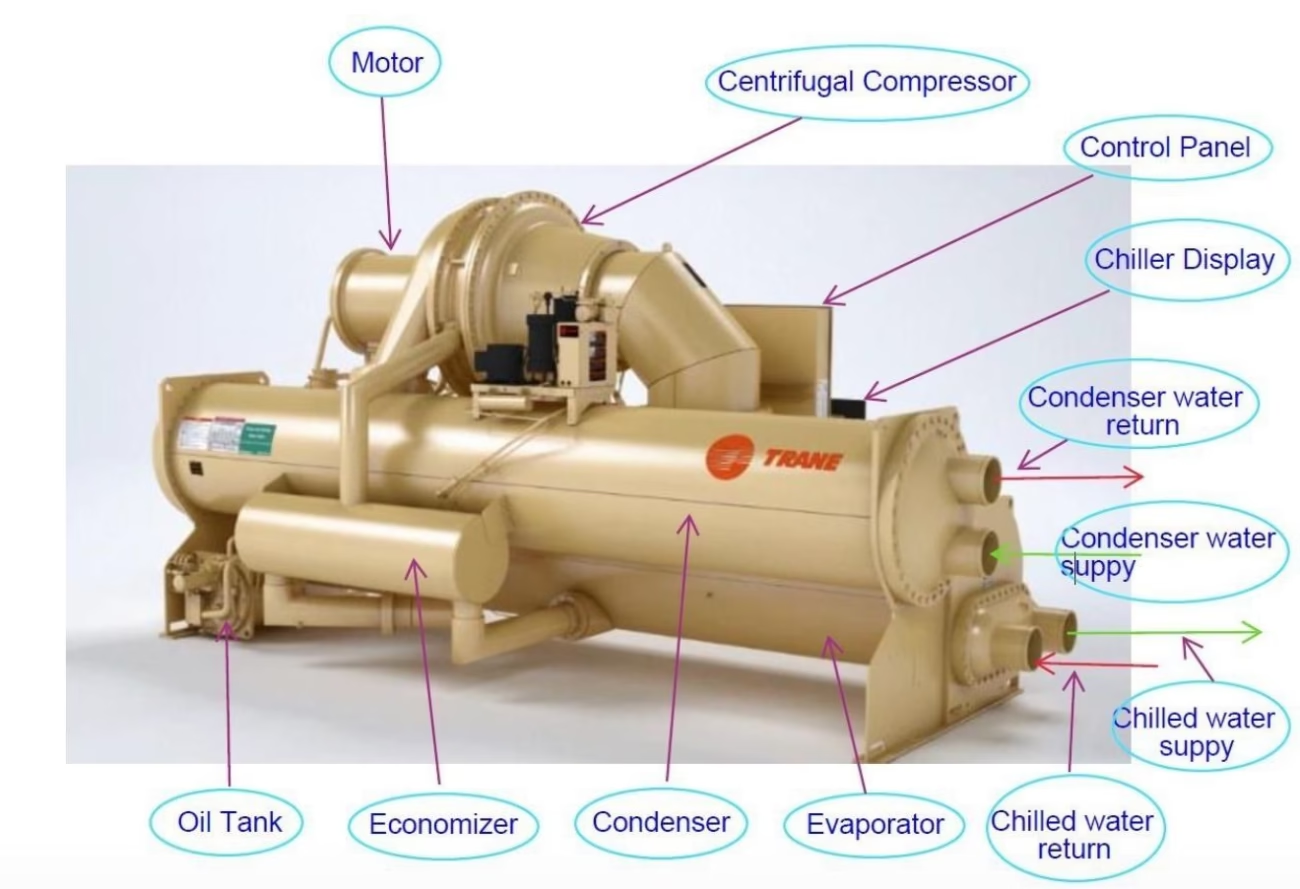
In most chiller plants, performance discussions revolve around Delta T, flow rates, and cooling tower efficiency. These are critical but they don’t reveal the full picture.
One of the most ignored factors sits inside the refrigerant circuit: the oil system.
It doesn’t show alarms.
It doesn’t leak visibly.
But it silently impacts heat transfer, compressor performance, and energy consumption.
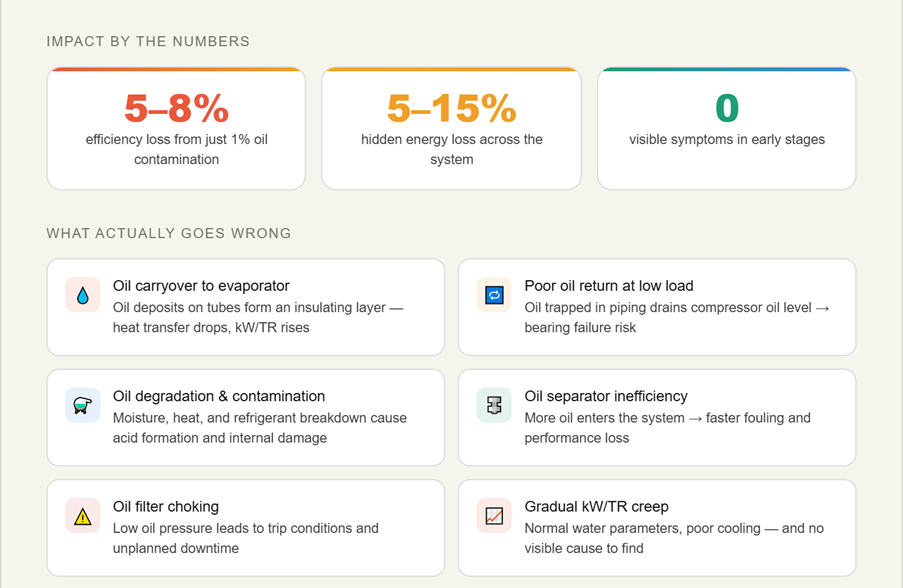
In many audits, oil system issues alone account for 5–15% efficiency loss.
The following visual summarizes how oil-related issues impact chiller performance and energy efficiency:
Why the Oil System Is Underrated but Critical
In real projects, focus is usually on:
- Delta T
- Flow balancing
- Cooling tower performance
But oil remains hidden inside the system, so early-stage issues go unnoticed.
However, it directly affects:
- Heat transfer efficiency
- Compressor life
- Energy consumption (kW/TR)
From a thermodynamic perspective:
- Oil forms a thermal resistance layer on heat exchanger surfaces
- Reduces overall heat transfer coefficient (U-value)
- Increases compressor lift (condensing – evaporating pressure)
- Results in lower COP and higher power consumption
What Actually Goes Wrong in Real Systems
At one audited site, all parameters looked normal design Delta T, stable flow, and acceptable cooling tower performance.
Yet, energy consumption was ~12% higher.
The root cause was not on the water side.
It was oil carryover inside the evaporator.
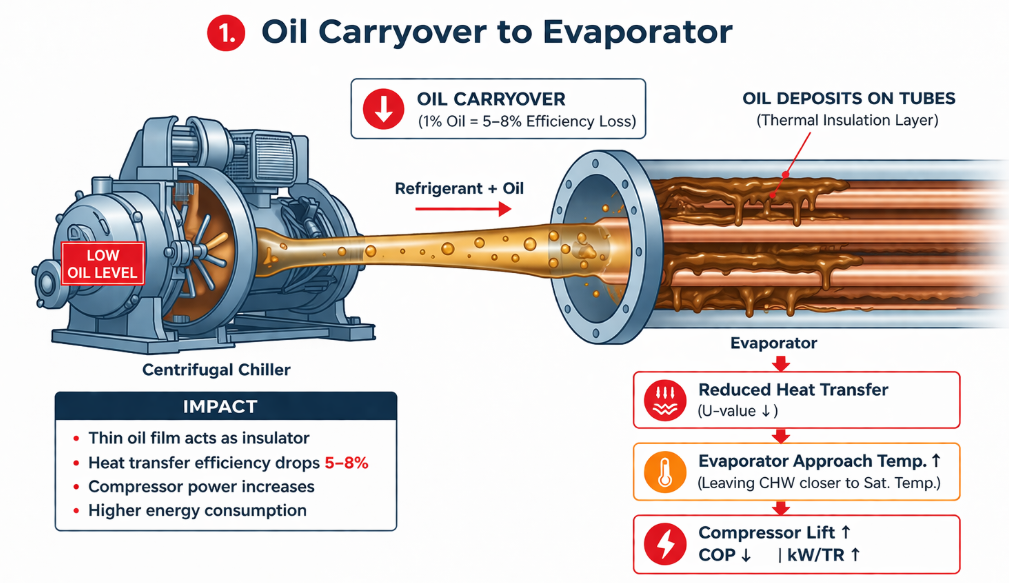
1. Oil Carryover to Evaporator
Oil circulates with refrigerant and deposits on evaporator tubes, forming a thin insulating layer.
Impact:
- Heat transfer drops significantly
- Evaporator approach temperature increases
- Compressor works harder → higher kW/TR
Key Insight:
Even 1% oil contamination can reduce efficiency by approximately 5–8%.
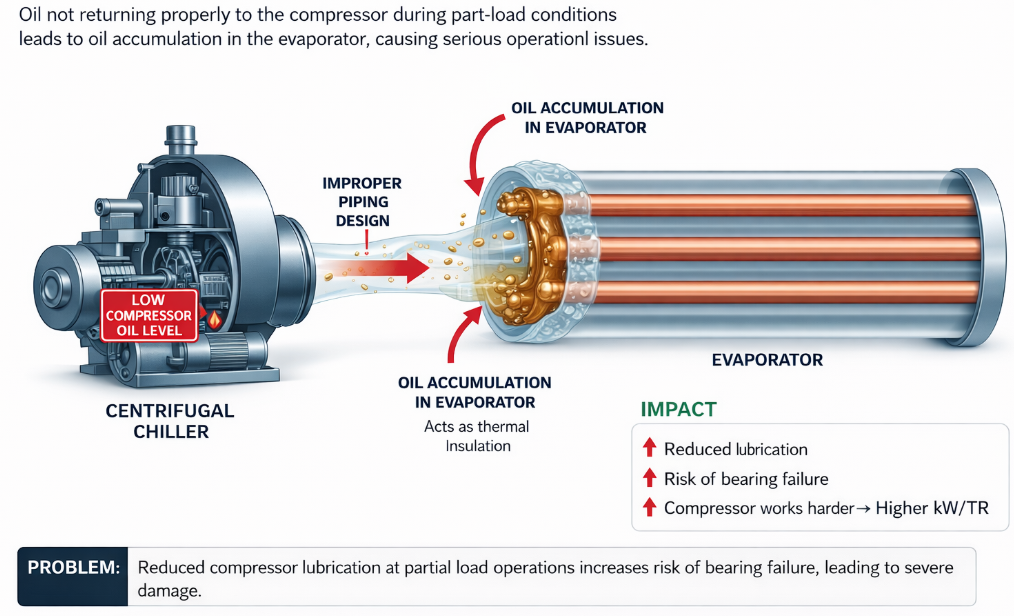
2. Poor Oil Return (Especially at Part Load)
Oil return depends on refrigerant velocity. At low loads, velocity reduces, causing oil to accumulate in evaporators or piping.
Common reasons:
- Low load operation
- Improper piping design
- Oversized systems
Impact:
- Reduced compressor oil level
- Inadequate lubrication
- Risk of bearing failure
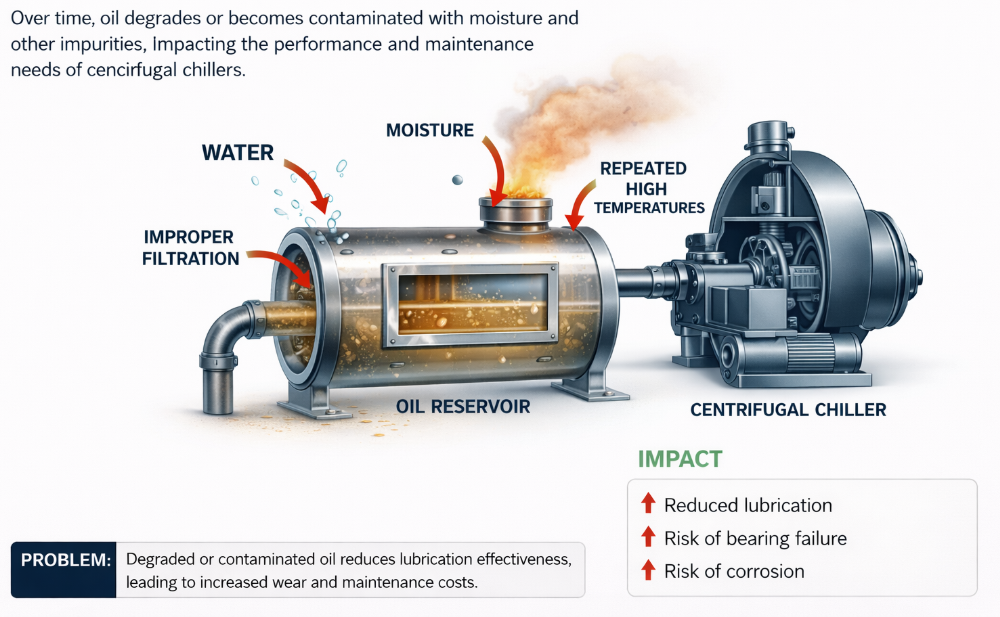
3. Oil Degradation and Contamination
This typically starts due to adverse system conditions:
- Moisture ingress
- High operating temperatures
- Refrigerant breakdown
Impact:
- Loss of lubrication properties
- Increase in acidity (high TAN)
- Internal corrosion and long-term damage
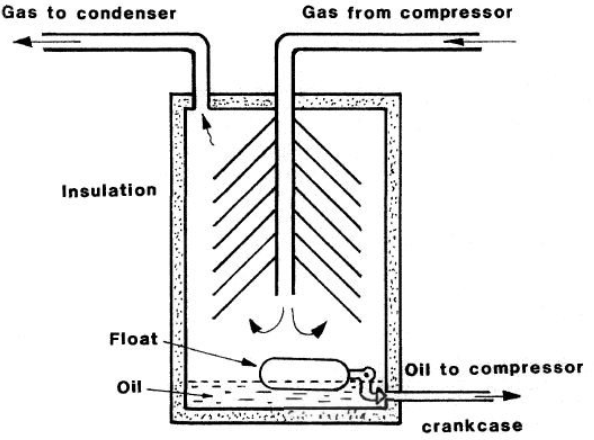
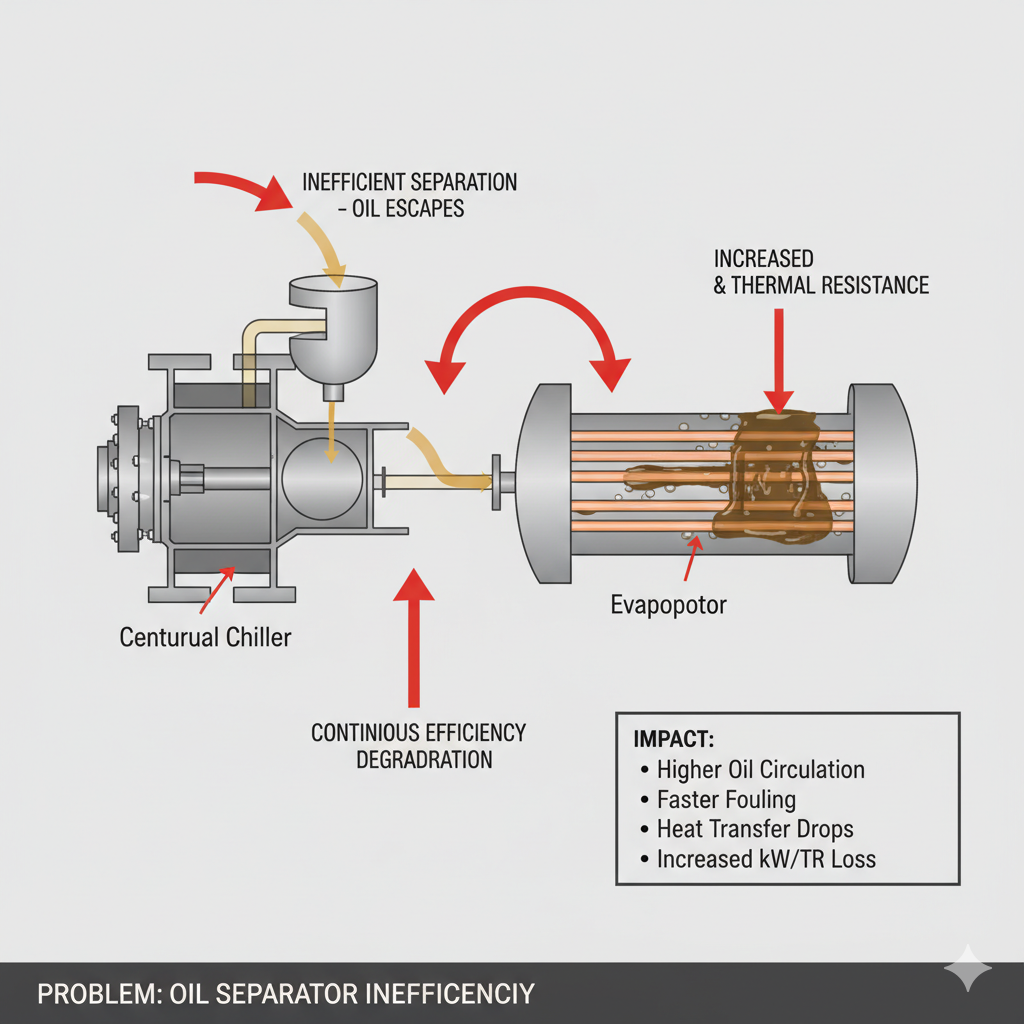
4. Oil Separator Inefficiency
The oil separator is responsible for removing oil from the refrigerant stream. Inefficiency leads to higher oil circulation.
Impact:
- Increased oil presence in heat exchangers
- Faster fouling
- Continuous efficiency degradation
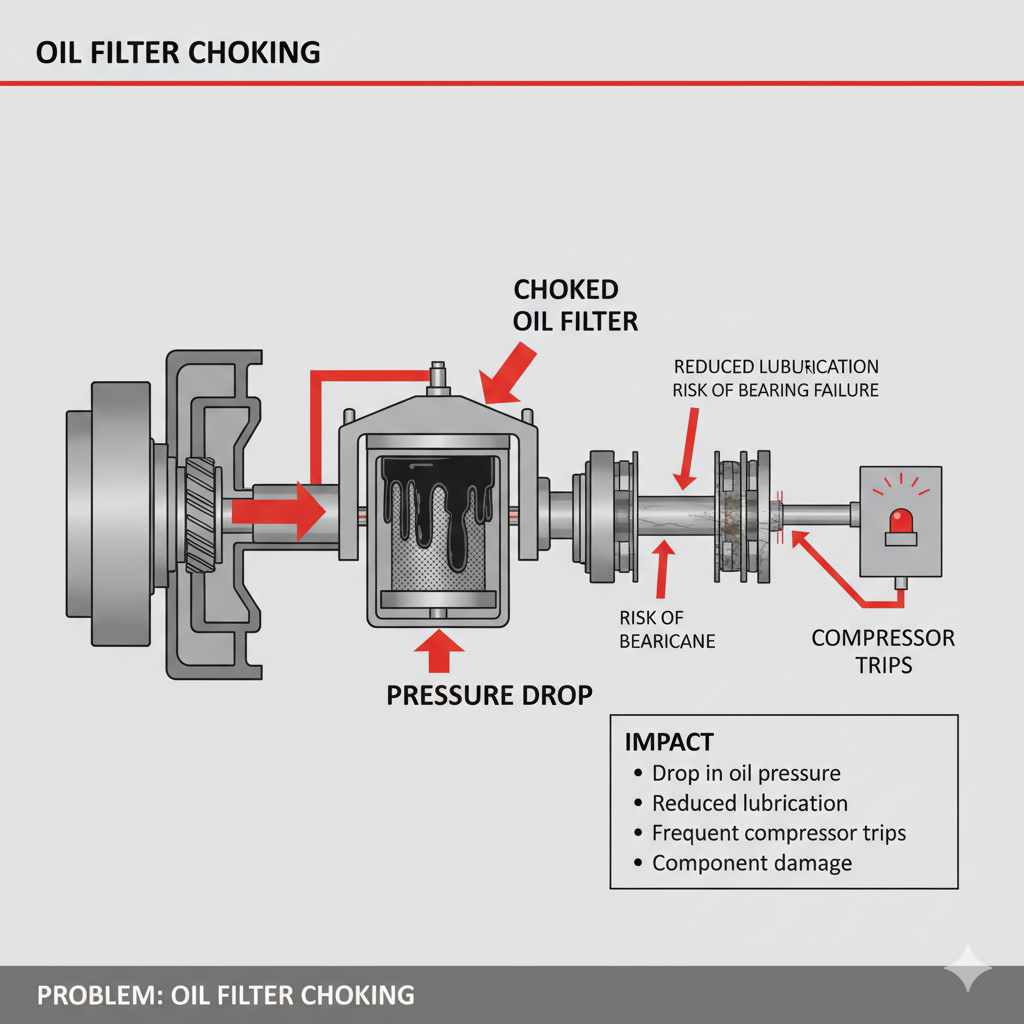
5. Oil Filter Choking
Oil filters trap contaminants but can clog over time.
Impact:
- Drop in oil pressure
- Reduced lubrication
- Frequent compressor trips
How Oil Issues Reflect in Plant Operation
Oil-related problems are not directly visible, but patterns can be observed:
- Gradual increase in kW/TR without system changes
- Cooling not matching design despite correct flow
- Increasing evaporator and condenser approach temperatures
- Occasional compressor trips (oil pressure/temperature)
- No visible issue in cooling tower or hydraulic system
Technical Indicators to Monitor
For engineers and auditors, these parameters are critical:
- Evaporator approach temperature
- Condenser approach temperature
- Suction and discharge pressures
- Compression ratio (discharge / suction pressure)
- Oil pressure differential across filters
- Oil level trends over time
An increasing compression ratio directly increases compressor work and energy consumption.
Practical Diagnostic Approach
A structured approach helps identify oil-related inefficiencies:
1. Monitor Oil Behavior
- Track oil level trends (not just snapshot values)
- Identify fluctuations indicating poor return
2. Measure Oil Parameters
- Oil pressure differential
- Filter pressure drop
3. Conduct Oil Analysis
- Moisture content (ppm)
- Total Acid Number (TAN)
- Viscosity
4. Monitor System Performance
- Track approach temperatures
- Identify hidden fouling trends
5. Corrective Actions
- Perform oil logging / recovery if required
- Check separator performance during maintenance
Why This Issue Gets Missed
Oil system problems are often overlooked due to:
- Lack of visible symptoms
- Dependence on lab testing rather than field observation
- Perception that it is OEM scope
- Limited focus on refrigerant-side diagnostics
Engineering Perspective: Thermodynamic Impact
Oil contamination leads to:
- Increased thermal resistance in heat exchangers
- Reduced effective heat transfer area
- Higher condensing temperature
- Lower evaporating temperature
- Increased compressor lift
All of these result in lower system efficiency and higher energy consumption.
This is not a minor issue it is a core thermodynamic degradation.
Conclusion
Oil system issues in chillers are silent but significant. They do not trigger immediate alarms, yet they gradually degrade performance, increase energy consumption, and reduce equipment life.
For any serious energy audit, oil analysis should be a standard practice not an afterthought.
In many plants, this single factor explains 5–15% hidden energy loss without any obvious fault.
The next time a chiller consumes more power than expected, the issue may not be on the air side or water side it may be inside the refrigerant circuit.
⚡ Enjoyed this article? Stay updated with weekly Chiller, HVAC & Energy Hacks — straight on WhatsApp!
💚 Join Our WhatsApp Channel
Great Detailed Article on chiller Energy Efficiency and effect of Oil Fouling. We have a product Called “Frigi-Tech” for the permanent Solution of oil fouling. Which enhace thermal Conductivity & Lubrication. We Delivered perfomace with Gauranteed Savings. For more detail visit ; http://www.greenwaveindia.in