
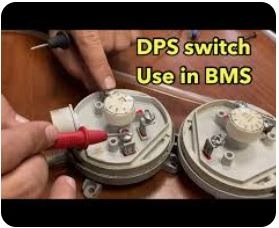
A Differential Pressure Switch (DPS) is one of the simplest devices in an AHU, yet one of the most critical. It does not control airflow, optimize energy, or make systems intelligent. Its job is far more basic—and far more important.
It doesn’t calculate, optimize, or modulate anything. It simply answers one critical question:
It tells you whether the system is actually doing what you think it is doing.
What a DPS Really Is (and What It Is Not)
A DPS is a simple mechanical device that senses the pressure difference between two points and changes its contact when a preset value is crossed.
or we can say that A DPS senses the pressure difference between two points and changes its contact when a preset limit is crossed.
As per experience if there No signals, no PID, no fine control.
- It does not control airflow
- It does not regulate pressure
- It exists purely for proof, safety, and protection through alarms
- Output is binary: ON or OFF
- It is not meant for control or modulation
Think of it as the system’s truth detector.
⚡ Enjoying this article? Stay updated with weekly HVAC & Energy Hacks — straight on WhatsApp!
💚 Join Our WhatsApp ChannelWhere DPS Is Used in an AHU (Real Applications)
1. Filter Choking Detection
This is the most common use and also the most frequently misunderstood one that i have seen on site.
The DPS is connected:
- One side before the filter
- The other side after the filter
As the filter loads with dust, pressure drop increases. When it crosses the set value, the DPS trips and tells the BMS:
Filters are dirty. let’s clean or replace them, that’s the common practice i have seen on site.
In most systems:
- This is an alarm only
- The AHU continues to run
- Maintenance decides the replacement schedule
Simple, effective, and energy-saving if used correctly.

2. Fan Airflow Proof – The Most Critical Role
A running fan does not guarantee airflow.
Best site practice:
- High-pressure port connected to fan discharge plenum
- Low-pressure port left to atmosphere (inside AHU or return section)
Why this works better than suction-to-discharge:
- It proves the fan is actually pushing air into the duct
- It avoids false proof when a downstream damper or fire damper is closed
This DPS answers a life-saving question:
“Is air really moving, or is the fan just spinning?”

3. Heater and Coil Protection
For heaters, airflow proof is not optional.
If air stops and the heater stays ON:
- Coils burn
- Fire risk increases
- Equipment damage is guaranteed
That’s why, in many projects:
- The heater airflow DPS is hard-wired
- It physically cuts heater power
- BMS only monitors the status
Software logic is good.
Hard-wired safety is better.

Why DPS Matters
From site experience, DPS prevents:
- Heater failures
- Coil freezing
- Fans running blindly against closed systems
- Energy waste due to choked filters
- Compliance failures in pharma and hospitals
Most importantly, it prevents assumed operation, which is where most HVAC failures start.
How DPS Actually Works
Inside the DPS:
- A diaphragm senses pressure difference
- A spring sets the trip point
- A micro-switch changes contact.

When Delta-P exceeds the set value, the contact flips.
Because it’s mechanical, DPS devices are:
- Reliable
- Easy to test
- Predictable during failures
DPS vs DP Transmitter – Clear Line You Should Never Cross
Here’s the rule that avoids 90% of confusion on site:
- DPS = proof and safety
- DP Transmitter = control and optimization
If you need:
- ON / OFF confirmation → DPS
- Continuous value for control → DP transmitter
Trying to control pressure using a DPS is simply wrong.
| Parameter | DPS (Differential Pressure Switch) | DPT (Differential Pressure Transmitter) |
|---|---|---|
| Basic Function | Provides proof or alarm | Measures and reports pressure continuously |
| Output Type | Binary (ON / OFF) | Analog (4–20 mA or 0–10 V) |
| Nature of Signal | Discrete status | Continuous value |
| Accuracy | Low (threshold-based) | High (measured value) |
| Typical Use | Safety, interlocks, alarms | Control, monitoring, optimization |
| Control Capability | Cannot control | Used for PID control |
| Use with VFD | Not suitable | Fully suitable |
| BMS Input Type | Digital Input (DI) | Analog Input (AI) |
| Typical Applications | Fan airflow proof, filter dirty alarm, heater safety | Room pressure control, duct static control, filter trend analysis |
| Response Expectation | “Is condition met?” | “How much pressure exists?” |
| Installation Sensitivity | High (tubing, moisture, range) | Moderate (needs calibration) |
| Maintenance Needs | Low, mechanical | Periodic calibration required |
| Cost | Low | Higher |
| Failure Impact | Missed alarms or nuisance trips | Control instability or wrong modulation |
| Best Role | Truth check and protection | Control and performance tuning |
Delta-P Settings – Where Most Mistakes Happen
Filter DPS Settings (Typical)
- Pre-filter: around 100–150 Pa
- Fine filter: around 250–300 Pa
- HEPA: as per OEM, often 400–600 Pa
Golden rule:
Never set DPS at clean filter pressure.
Set it around 1.5 to 2 times the clean value.
Fan Airflow Proof Settings
These are low values, because the goal is proof, not measurement.
- Supply fan: roughly 30–80 Pa
- Return or exhaust: slightly lower
If airflow exists, DPS should trip. That’s all it needs to do.
Practical Field Problems
- DPS range too high → diaphragm never reacts
- Tubing connected backwards → false healthy status
- Long or sagging tubes → delayed response
- Moisture trapped in tubing → random alarms
A very common issue:
Condensation forms in sagging tubes and blocks pressure transmission.
Solution
- Keep tubing short
- Maintain continuous slope
- Avoid U-loops
- Provide drain points if required
Open Tubes vs Static Pressure Probes
- For filters: open-ended tubes are fine
- For fan airflow proof: static pressure probes are better
High air velocity blowing directly into a tube can create false readings. Static probes avoid that.
This small detail makes a big difference in high-speed systems.
DPS and BMS – How They Work Together
From a BMS point of view:
- DPS is wired to a digital input
- Usually as a dry contact
Typical fan proof logic:
- Fan command ON
- Delay timer (10–20 seconds)
- Check DPS status
- If not proven → trip and alarm
For filters:
- Continuous monitoring
- Alarm only
- No shutdown unless process demands it
Limitations of DPS
A DPS:
- Cannot modulate or control airflow
- Does not show actual pressure values
- Is sensitive to poor installation (tubing, moisture, vibration)
- Can drift over time if abused
It is reliable—but only when installed and used correctly.
Advancements Around DPS
Modern systems improve DPS usage by:
- Pairing it with DP transmitters (safety + control)
- Using smarter BMS logic with delays and confirmations
- Applying predictive maintenance using pressure trends
- Improving accessories like probes and moisture-resistant tubing
The DPS itself is simple—but the system around it has become smarter.
Final Takeaway
A Differential Pressure Switch will not improve your efficiency numbers on paper.
What it does is far more important — it tells you the truth about what’s really happening inside the system.
It makes it clear:
- Whether air is actually moving or the fan is just running
- Whether filters are genuinely loaded or just assumed to be fine
- Whether it is safe to keep the equipment running or time to stop
When applied and set correctly, a DPS quietly protects equipment, people, and regulatory compliance.
When installed casually or ignored, it turns into just another alarm that no one trusts.
